Showing posts with label basic. Show all posts

Friday, April 18, 2014

Wine Words

Have you ever had a glass of wine that you loved so much, but couldn't find the words to describe it? Acquiring a good wine vocabulary will make you a more knowledgeable wine drinker and allow you to really express your interest in the juice. I became rather inspired one day and created a list of words I use when I review wine. Feel free to use these words the next time you drink wine!  


Acidic * wine has high acid; it tastes sour and tart
Aggressive * wine has harsh tannin and high acidity
Big * wine is full bodied and tastes intense
Bitter * wine has too much tannin (usually with younger wines)
Bright * wine is higher in acidity; it is mouth watering with clean flavors
Bold * wine is strong and intense with distinct aromas and flavors
Chewy * wine has high tannin and dries out the mouth
Clean * wine tastes fresh; there are no flaws in aroma or flavor
Coarse * wine has a texture of harsh tannin or bubbles (in sparkling wine)
Complex * wine is perfectly balanced and contains a variety of aromas and flavors; it makes you want to keep drinking (usually older wines)
Creamy * wine is heavier and smoother in body (almost always oaked)
Crisp * wine is refreshing and has perfect acidity (almost always white wines)
Decadent * wine has layers of flavor; the body is large and the texture is luxurious (like a rich dessert!)
Delicate * wine is light and subtle
Elegant * wine is gracefully balanced; it is not too bold or fruity
Fat * wine has a high alcohol content and has very low acid; it tastes concentrated (can become flabby)
Firm * wine has a balanced acid, alcohol, and tannin structure
Flabby * wine has too much alcohol and is lacking in acidity; there is not enough structure
Fresh * wine is clean and fruity; the acidity is perfectly balanced
Green * wine is sour or tart and sometimes has vegetal flavors (can be unripe, immature)
Harsh * wine has too much acid, alcohol, or tannin; it is not balanced
Hot * wine has too much alcohol (burning sensation)
Intense * wine is vibrant and aromatic (usually with good texture)
Jammy * wine has a concentrated or cooked fruity flavor (from ripe grapes)
Juicy * wine has a grape juice taste
Lively * wine is fresh, fruity, and bright
Long * wine has a lingering aftertaste
Lush * wine is soft and velvety; it is concentrated and rich in fruit
Mellow * wine tastes softer (can be sweet, fruity, or juicy)
Mild * wine is lacking character; it has simple characteristics and flavors
Oily * wine does not have enough acid; its texture is slippery
Powerful * wine has an abundance of acid, alcohol, and tannin (bigger than big)
Prickly * wine is very acidic and has a sharp mouth feel
Perfumed * wine has strong floral characteristics; it is fragrant (usually white wines)
Refreshing * wine is crisp and thirst quenching
Rich *wine is full and flavorful; it has ripe fruit and oak flavors (usually rounder)
Round * wine has a soft texture and smooth tannin; it is balanced and mature
Rustic * wine has woody and earthy flavors and is usually aged (less fruity flavors)
Sharp * wine tastes bitter and unpleasant
Silky * wine is creamy and velvety; it is easy to drink
Simple * wine lacks complexity; it has no specific flavors or characteristics
Smooth * wine has mild acidity and tannin; it is well balanced and easy to drink
Soft * wine is lighter; it has low acid and low tannin usually
Subtle * wine has little flavor; it has a light and delicate texture (still sophisticated)
Supple * wine is smooth and round; it has good body, tannin, and oak
Tannic * wine has firm or rough texture (dries out the mouth)
Tart * wine is sharp and acidic (usually unripe)
Thick * wine is rich and concentrated; it is usually low in acid
Thin * wine lacks body and structure, it is diluted (like water)
Tight * wine is too bitter; it has too much tannin and is not quite ready to drink (best to decant)
Velvety * wine is smooth and silky; it has rich flavors
Vibrant * wine has mouthwatering acidity; it is bright and alive

Zesty * wine has lively flavors; it tastes crisp with higher acidity

Friday, January 31, 2014

TASTING part two


Here we go again. 

I put together some important wine characteristics that you want to think about while tasting wine...


...beyond red and white

Newer red wines will have more of a deep purple color, while older red wines (that have been aged for a while) will have a brown or orange tint and more of a brick color

Red and white wines will either be more translucent or more opaque than others. This usually tells you what type of grape is used. For example, Pinot Noir is more translucent than most other red wines and Sauvignon Blanc is more translucent that most other white wines (you can see through the wine in the glass).


What you smell in a glass of wine is referred to as the aromas or bouquet (in older wines). 

You can pick up a variety of common aromas in white wines, such as lemon, citrus, apple, peach, pear, melon, butter, vanilla, grass, herbs, stone, rocks…
You can pick up a variety of common aromas in red wines, such as dark berries, cherry, plum, pepper, cinnamon, earth, wood, chocolate, mocha…


Immediately you will pick out flavors in wine after taking a sip (sometimes these flavors match the aromas).

Chardonnay might have tastes of apple, pear, citrus, butterscotch, and oak.
Merlot might have tastes of blackberry, cherry, plumb, oak, and mocha. DELICOUS.

Also you should decide if the wine is sweet or dry. It is either one or the other. 
Sweetness and dryness refer to the original sugar content of the grape used. If all the sugar is converted to alcohol the wine is considered dry. If only some of the sugar is converted to alcohol the wine has residual sugar and can be considered sweet, semi-sweet, or off-dry.

Is the wine fruity
Don’t confuse sweetness with fruitiness. If a wine is fruity that means you can easily pick out the fruit flavors in the wine, but that doesn't always mean the wine is sweet. It can be fruity and dry!

Here is a good way to look at it:
A wine CAN be fruity and sweet
A wine CAN be fruity and dry
A wine CANNOT be sweet and dry

Eventually you’ll start to consider


This is how the wine feels in your mouth. Many relate it to the way milk feels in your mouth. Is it light (like skim milk) medium (like 2% milk) or full (like heavy cream)?


The last part of tasting focuses on THREE MAJOR COMPONENTS in wine. These are Alcohol, Acid, and Tannin. If these three components are balanced well, the wine is usually great!


This is an element found in the pulp of the grape. A wine needs acid to taste lively.


This is what is produced when yeast and sugar come together. It affects the body and texture of the wine. 
High alcohol wines will taste full and round in your mouth. 
Low alcohol wines will taste light and airy in your mouth. 
If a wine has a high alcohol content it will also need a high level of acid to taste balanced.


This comes from the skin and the seed of the grape. It is the bitterness you taste in wine. If a wine seems to dry out my tongue I know it has higher tannins. 

Friday, January 24, 2014

TASTING part one

Last night I was able to attend my restaurant’s wine tasting event with my husband and a couple friends.


Wine tastings make me so very happy. 


I love being able to try a variety of wines and learn about them as I taste them.


I have spent the past couple of years attempting to learn the art of tasting wine (you know... like the pro's do it). I have been swirling, smelling, sipping, and trying to figure out the exact flavors I taste in a glass of wine. At first it's not very easy. I used to think all red wines tasted the same. Later, I realized they most definitely do not. 
After drinking more and more wine, I started to discover different fruit flavors. I could point out the tastes of earth, wood, and flowers.
I read many online reviews and learned that there is no right answer to what tastes you find in wine (although there are common ones specific to certain types of wine). It’s really a matter of what YOU taste that is all part of the enjoyment of wine tasting.

Here is a bit I have learned about HOW TO TASTE WINE...


1. The glass should be ⅓ full or less (you usually get one ounce pours at tastings).
2. Tilt your glass against a white background and notice the color (I never cared about this until I started learning about different types of wine and what they were supposed to look like...sometimes I skip this step).
3. Hold the stem of the glass and rotate it (easier if you have a table to rest the glass on) to get the wine swirling around the glass.
4. Stick your nose in the glass as far as it will go.
5. Your first inhale is the most important! What comes to mind first? Citrus? Wood? Spice? Dirt? There are so many aromas to wine.
6. Take a sip of the wine and roll it around your tongue. Is it Sweet? Tart? Acidic? Heavy? What words come to mind?


Eventually I’ll share some common descriptions and what they mean, but until then taste away...the randomness is all part of the fun!

Friday, January 17, 2014

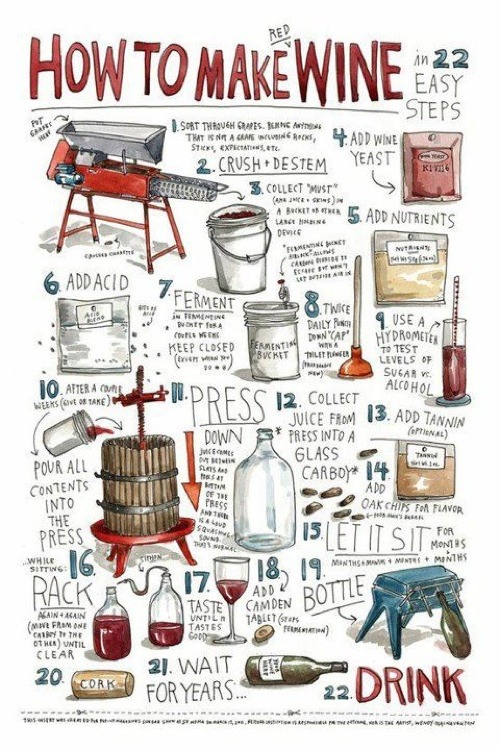
Making Wine


How do grapes become wine?


I didn't give much thought to that until a few years ago when my husband and I decided to make wine at home. I wish I could say we picked and stomped the grapes ourselves and went through the process like knowledgeable wine makers.
...Instead we bought the juice that came to us in a jumbo size plastic bag and crammed into our tiny apartment kitchen following the directions given to us in our wine-making packet.

Here is the gist of it (starting from the vineyard):


The best grape is one that is grown in good sunlight, in good soil, and with good drainage. These grapes make for the best wine! Once the grapes are ripe on the vine they are picked (by hand or machine) and the bad grapes are sorted out.


Grapes are stemmed and crushed (using a grape crusher, although there are people that still use their feet!). White wines are pressed so their skins are removed. The grape juice is strained into a tank, usually stainless steel (we just poured ours from a bag into a very large bucket).


Yeast is added to the tanks (or bucket). Yeast turns the sugars in the grape juice to alcohol and carbon dioxide is released. This can last a couple days to a week or so. Ours was done in a few days.


After fermentation, red wines are pressed so the skins are removed. Red and white wines usually transfer over to another vessel (usually a barrel) to mature (sometimes called secondary fermentation). Our wine went into a five gallon glass carboy. At this point air is the enemy. Any contact with oxygen can ruin the wine. After three months or so wine can be transferred to another vessel to continue the aging process. This usually helps rid of sediment that has gathered on the bottom of the vessel. Wine can mature from six months to three years. We let ours sit in our apartment for four months (maybe a little less).

NOTE: Wines that mature in stainless steel usually have more fruit forward flavors, while barrel matured wines have more earth, oak, and caramel flavors.


Wine is usually filtered before bottling. We siphoned our wine into extremely clean bottles we had kept. We corked the bottle with a corking device and let the bottles hang out for a few more months.


My husband and I have made wine three times. A Chardonnay, Shiraz, and bold Italian Borolo.

How To Make Wine ?


Found on the Khooll


Friday, January 10, 2014

Oh Glorious Grape

 ...and not the kind you pack in your lunch box!


Wine grapes are different from the kind you buy at a store. They are smaller and thicker skinned. Have you ever tried a Concord grape? When you bite into this grape the juice oozes out and you end up chewing on the skin for a while. Like the Concord grape, wine grapes are much sweeter and juicier than your usual fat and fleshy picnic grape. They are made for juicing!

The TWO MOST IMPORTANT ELEMENTS of a grape (that lead to an irresistible glass of wine):

The pulp  (most important) This is the flesh inside the fruit. It’s made up of sugar, acid, and water. As a grape ripens, the sugar increases and acid decreases. The grapes are harvested (gathered) when there is a good balance between sugar and acid. Without acid your wine would taste dull (like flat soda )

The skin    This is either Red (purple/blue) or Green (yellow). Red skinned grapes give red wine its color if the skin is left on the grapes during fermentation (fermentation is the process of grape juice to alcohol). If the skin isn't left on the grape during fermentation, the wine will be white. If the skin is left on for partial fermentation the wine will be pink.

Red skinned grapes can produce red, pink, and white wines. Green skinned grapes only produce white wines.
Also, the skin contains tannin's (the bitterness you sometimes taste in wine... or the source that dries out your tongue) which is also a natural preservative that allows most red wines to age for years.

The grapes you (should) know...


Green
  • Chardonnay
  • Riesling
  • Pinot Grigio
  • Sauvignon Blanc
  • Moscato


and some more...
  • Chenin Blanc
  • Gewerztraminer
  • Viognier
  • Semillon


and some that Ohio really likes…
  • Vidal Blanc
  • Seyval Blanc
  • Traminette


…and hundreds more

Red
  •  Cabernet Sauvignon
  • Merlot
  • Pinot Noir
  • Zinfandel
  • Shiraz/Syrah


and some more…
  •  Malbec
  • Sangiovese
  • Nebbiolo


and some that Ohio really likes…
  • Catawba
  • Cabernet Franc
  •  Marechal Foch


There are hundreds of grape varieties. Each of them influence the flavors you love in a glass of wine!